Choose a pellet smoker for the food you want to cook slowly, the space you can use safely and the maintenance you are willing to do. For a first purchase, put usable grate space, clear controls and easy cleaning ahead of app features. If your main aim is quick steak searing, check that capability separately before buying.
Sizl has not tested a pellet smoker for this guide. It is based on manufacturer operating documents, published specifications and official outdoor-fire guidance. The recommendations are shopping criteria rather than a ranking of models. No price, fuel-use rate or unattended runtime is assumed.
Is a pellet smoker right for the way you cook?
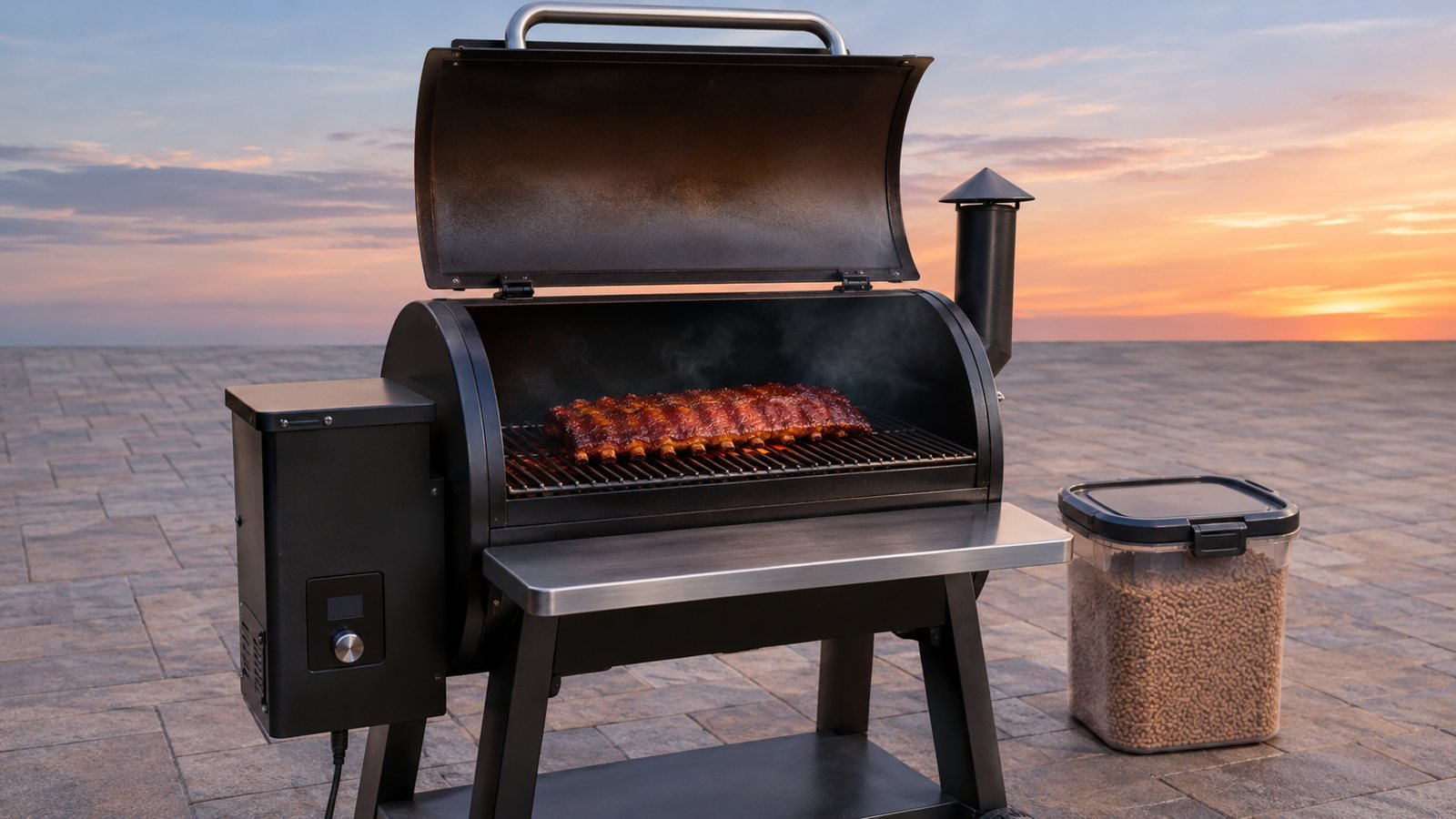
A pellet smoker combines burning wood fuel with powered controls. Weber explains the mechanism: an auger moves pellets from the hopper to the firepot, while electricity powers the feed system, fan, ignition and controller. You need both suitable pellets and a suitable electrical supply.
That combination makes sense if you want to cook ribs or a roast without manually adjusting a charcoal fire throughout the session. It does not turn outdoor cooking into an appliance you can ignore. The control system handles a job for you; the owner still has fuel, food and equipment to monitor.
Before choosing a size, make a meal list. Write down the cuts you intend to cook and whether the smoker will complement an existing grill. A buyer who already has a good searing setup can concentrate on smoking performance. Someone replacing every outdoor cooker needs a closer look at the proposed replacement’s limits.
- Main benefit: powered fuel delivery and temperature control reduce manual fire adjustment.
- Main trade-offs: dependence on electricity, dry pellets and maintained internal parts.
- Best fit: a cook who wants regular smoking and roasting sessions.
- Reason to reconsider: you mainly want a simple appliance for quick, direct-heat meals.
Our recommendation is to buy for the sessions you expect to repeat. A smoker purchased for an imagined holiday feast can be the wrong fit for a small patio and ordinary weekend meals.
How much cooking space and hopper capacity do you need?
Compare the shape and accessibility of the cooking area, not just a headline area figure. Traeger’s pellet-grill guide names size among the main buying considerations. Translate that into a practical question: will the actual food you plan to smoke fit comfortably with the lid shut?
Ask for the main grate’s dimensions and the clearance under upper racks. An advertised total may combine surfaces you cannot use the same way for a tall roast. Bring the dimensions of your usual roasting pan or serving tray to the showroom, rather than relying on a photograph crowded with food.
Reach matters too. If removing a rear rack requires lifting food over something else, decide whether that inconvenience is acceptable. Check the lid’s opening path, the width with shelves attached and the route between storage and the cooking position. These checks turn a capacity claim into a setup you can picture using.
Treat hopper capacity as fuel storage rather than a promise of hours without attention. This guide has not established a model-specific burn rate, so it cannot convert a hopper size into a dependable runtime. Ask for the manufacturer’s explanation of operating conditions, and plan to check the fuel during cooking.
A hopper cleanout is worth inspecting in person. Can you empty it into a container without spilling pellets across the patio? Can you reach the opening easily? For occasional cooks, that practical detail may deserve more weight than a larger advertised hopper.
Can it smoke well and still sear a steak?
Separate a smoker’s temperature setting from the heat arrangement at the grate. Traeger’s grate guidance distinguishes lower positions for hotter, quicker cooking from upper positions suited to longer cooks. Its advice applies to those designs, not every pellet smoker on sale.
A maximum-temperature claim alone does not tell you how your steak will brown. Ask whether the exact model has a dedicated searing arrangement, what cooking surface it uses and whether any extra part is required. Read the instructions for that feature, rather than assuming every model carrying the word grill works alike.
Startup is another detail hidden behind the control panel. Traeger’s startup documentation gives different procedures for different controller families and directs owners to the correct manual. That is a good reason to request the manual for the exact model before purchase.
For the controls, ask to see temperature selection, ignition and shutdown demonstrated on an unlit display model. If an app is part of the attraction, confirm which jobs can be done at the grill and which require a phone. We would favor understandable local controls over connectivity that complicates a routine cook.
Choose a smoking-focused setup if ribs and roasts are the priority. If steak crust is non-negotiable, keep an existing searing method or seek credible evidence for the specific smoker’s searing feature. Sizl has not measured that performance here.
What will cleaning and pellet storage involve?
Cleaning access is a buying feature. Traeger’s maintenance instructions cover grates, the drip tray, grease routes and ash around the firepot, with different procedures by series. A convenient collection container does not establish that every internal surface cleans itself.
Ask to see the route to the firepot. Find out what must be lifted out, where the parts can rest and how the grease container detaches. If that job looks awkward in a showroom, account for handling greasy parts at home. Follow the chosen model’s instructions, and let it cool completely before internal ash cleaning.
Pellet condition also matters. Traeger’s pellet replacement guidance lists moisture, crumbling pellets and clumps of sawdust among warning signs. It also describes different hopper-emptying methods. Inspect those features before deciding where spare fuel will live.
Use cooking pellets approved for the appliance and plan dry storage. Traeger’s overview distinguishes cooking pellets from the pellets used for home heating. Don’t treat every bag labeled wood pellets as interchangeable fuel. Ask the seller to identify the correct fuel and the manufacturer’s storage advice.
Finally, read the shutdown instructions. Traeger requires the shutdown cycle to finish before the grill is powered off or unplugged. Buy with that routine in mind; ending a cooking session is more involved than immediately disconnecting the power.
What should you check before paying?
Confirm an appropriate outdoor location first. The U.S. Fire Administration says propane, charcoal and wood-pellet barbecue grills belong outside. Use the exact model’s manual for clearance and electrical requirements. A garage doorway is not a substitute for a suitable outdoor cooking position.
Then compare complete packages. Record which racks, food probes, shelves and covers are included, and which are optional. Ask where replacement probes, ignition parts and other service components can be obtained. Do not assume a long warranty covers every component for the same period; read its actual terms.
- Confirm that your usual food and pans fit the usable grates.
- Check power access and the safe cooking footprint against the manual.
- Understand the startup, fuel checks and full shutdown routine.
- Inspect access to grease, ash and hopper cleanout.
- Confirm the searing arrangement if it must replace your existing grill.
- Price the complete setup using current seller quotes, not this guide.
Our preferred first pellet smoker is the smallest setup that comfortably handles your normal meals and makes maintenance straightforward. Choose app control or extra racks when they solve a real problem for you. If cleanup access is poor or the searing claim is unclear, keep looking before committing.
Sources
Sources checked November 16, 2026. Operating details are manufacturer guidance; shopping priorities are Sizl’s editorial recommendations.
- Weber: Wood Pellet BBQ Grills & Smokers
- Traeger: Everything You Need to Know About Wood Pellet Grills
- Traeger Support: Cooking on Different Grill Grates
- Traeger Support: How to Start Your Traeger Pellet Grill
- Traeger Support: Cleaning Your Traeger Pellet Grill
- Traeger Support: How to Remove & Replace Pellets
- Traeger Support: How to Shut Down Your Traeger Pellet Grill
- U.S. Fire Administration: Outdoor Fire Safety