Buy a thin-probe instant-read meat thermometer first if you mainly grill burgers, chops and chicken pieces. Add a leave-in cooking thermometer when you regularly smoke or roast larger cuts and want temperature tracking and alarms. The first tool helps you check different pieces; the second follows a chosen location over time.
Sizl has not tested thermometers for this guide. It uses food-safety guidance from FoodSafety.gov and NC State Extension alongside ThermoWorks’ technical explanations. The recommendations below concern features and fit, not an untested model ranking. No advertised reading speed or wireless range is presented as a result measured by Sizl.
Do you need an instant-read or a leave-in thermometer?
An instant-read is our first recommendation for mixed grilling because you can check each item before serving. A leave-in instrument earns its place during longer cooking. ThermoWorks’ probe-safety guide explains that leave-in probes track temperature changes and can sound an alert when a target is reached.
| Type | Useful job | Buying check |
|---|---|---|
| Instant-read | Check individual pieces near serving time | Can its sensing area fit the food? |
| Leave-in cooking probe | Follow a roast during indirect cooking | Are probe and cable rated for that environment? |
| Ambient grill probe | Track the cooking environment | Does the kit include a suitable air probe and clip? |
Do not assume a temperature shown on the grill is the temperature inside your chicken. FoodSafety.gov’s guidance is to use a food thermometer to check the food’s internal temperature. A cooking-environment reading and a meat reading answer different questions, even when the same display can show both.
For a first purchase, choose the tool that fills the missing job. If you already have an instant-read and cook long roasts, a cooking alarm may be useful. If you have a grill display but no way to probe the food, start there. Extra channels are not a substitute for the right sensor.
Which accuracy and probe specifications matter?
Look for a published accuracy specification over the temperatures you will use, plus clear instructions for the probe’s sensing area. ThermoWorks’ accuracy guide explains that readings should be assessed against the instrument’s stated specification. It warns against judging accuracy by comparing thermometers in cooking food.
Don’t buy on the word instant alone. Ask how the maker defines its response time and whether the claim applies under stated conditions. A fast number on a screen is useful only if the probe can measure the part of the food you need to check. Sizl has not timed any candidate here.
Sensor location matters for thin foods. NC State Extension’s Measuring the Heat describes thermocouples with sensing at the tip and bimetallic instruments with a longer sensing area. A bulky sensing section is a poor match if it cannot sit within the food you usually grill.
When comparing instruments in a shop, hold each one as you would beside the grill. Can you read it without twisting your wrist? Can you operate its controls with your usual cooking hand? Is the probe easy to unfold or uncover? These are useful checks even when the packaging emphasizes technical features.
Ask about battery replacement, the warranty and the route for service. We would pass on an instrument whose maker provides no usable accuracy specification or probe instructions. You should be able to establish what it measures, how to use it and what to do if it becomes unreliable.
Where should you put the probe, and what temperatures count?
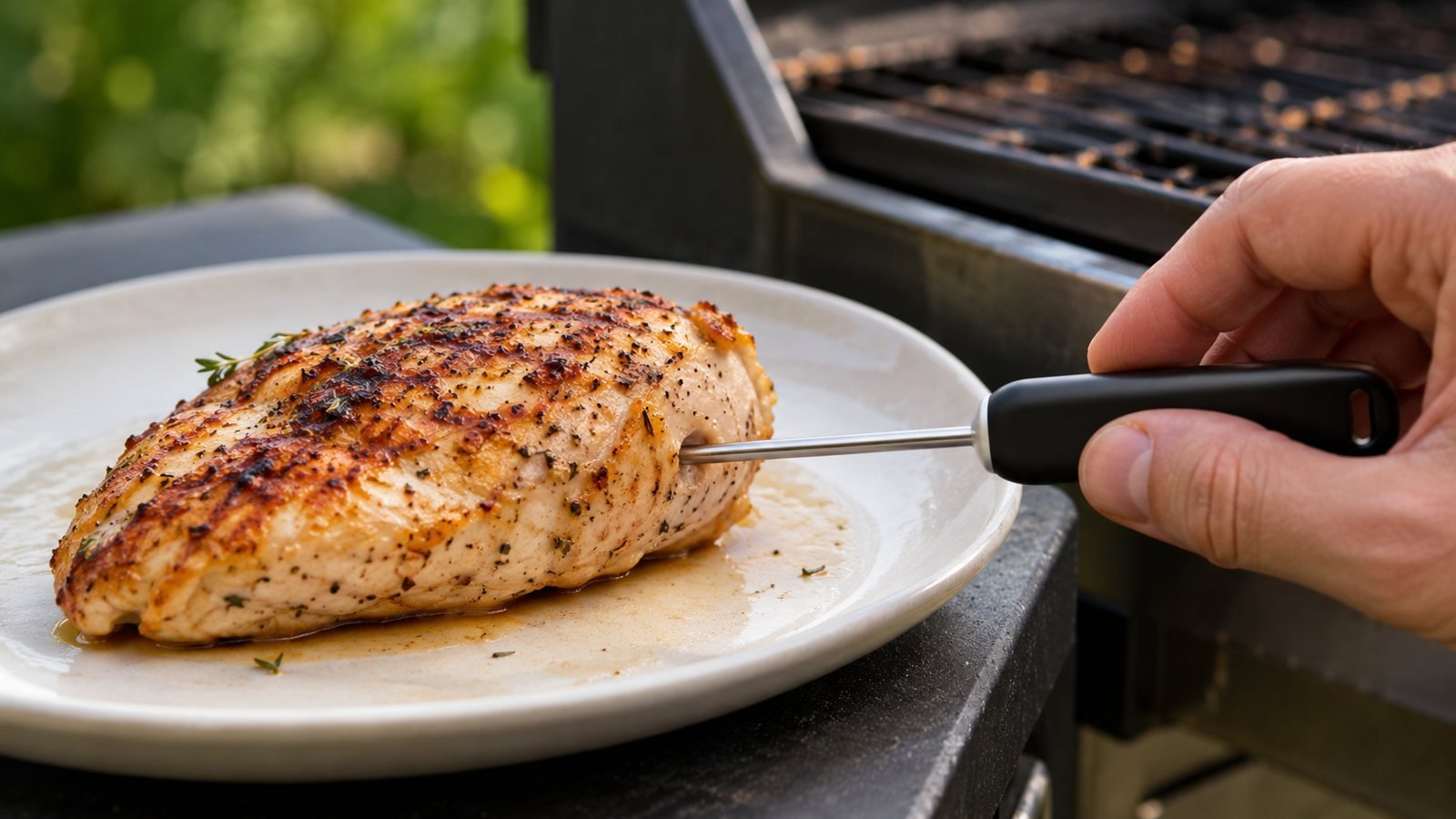
Put the sensing area in the center or thickest part of the food and check more than one location. NC State Extension advises checking at least two places. ThermoWorks’ general guidance similarly emphasizes finding the coldest part of the thickest portion, rather than accepting the first convenient reading.
For a thin patty, choose an insertion path that keeps the required sensing area inside the food. If the probe cannot fit that way, the instrument is poorly suited to the job. With several chicken pieces, check them individually; one warm reading does not tell you the internal temperature of the remaining pieces.
Use the FoodSafety.gov minimum-temperature chart for the food you are serving. Its guidance includes these common grilling foods:
- Chicken and other poultry, including ground poultry: 165°F.
- Ground beef and pork: 160°F.
- Beef, pork, veal and lamb steaks, chops and roasts: 145°F, followed by a three-minute rest.
These are food-safety minimums, not smoker-controller settings. Keep the full chart available for foods outside this list. If a recipe or an app’s doneness preset conflicts with the applicable minimum, use the official safety guidance. The right thermometer helps you measure; it does not decide which target is appropriate.
Will the probe survive grilling and cleaning?
Check the permitted exposure of every part, not just the metal probe tip. ThermoWorks warns that flare-ups can damage leave-in probe cables and says its cooking alarms are intended primarily for lower-temperature cooking environments. A product advertised for meat does not automatically tolerate direct flames.
If you use a leave-in probe during indirect cooking, follow the maker’s routing instructions and keep cables away from flames and damaging hot surfaces. ThermoWorks recommends using dedicated probe openings where available rather than trapping a cable under the lid. For direct grilling, our preference is quick checks with an appropriate instant-read.
Cleaning instructions deserve the same attention as heat limits. ThermoWorks distinguishes splash protection from broader water protection and advises cleaning a probe after contact with raw meat. NC State Extension recommends washing, rinsing, sanitizing and air-drying thermometer stems, using a sanitizer suitable for food-contact items.
Read the exact instrument’s care instructions before putting any part in water. A washable probe does not establish that the display unit or cable connection can be submerged. When comparing kits, ask which parts are replaceable and what a replacement probe costs from the seller, without assuming a universal price.
Our buying preference is a thermometer with plain care instructions and available replacement parts. A complicated set that you hesitate to clean is a poor fit for frequent grilling. For a wireless model, also confirm charging requirements, phone compatibility and how it alerts you to a lost connection before relying on it.
What is the sensible first purchase?
Start with a readable instant-read that has a suitably thin probe, documented accuracy and a clear checking procedure. Then learn how to verify it. NC State Extension recommends checking digital thermometers using the ice-point method. ThermoWorks stresses that the ice bath must be prepared properly and the probe must not rest against the vessel.
A correctly made ice bath provides a reference of 32°F. Follow the instrument maker’s method and its allowed tolerance. If the reading is outside specification, use its adjustment or service procedure; do not improvise an offset while cooking. Comparing two readings in a hot steak does not establish which instrument is correct.
- For burgers, chops and chicken pieces, prioritize probe fit and an easy-to-read instant-read display.
- For regular smoking or roasting, consider a leave-in alarm as an additional tool.
- For cooking-environment monitoring, confirm an appropriate ambient probe is included or available.
- For any model, read the heat limits, cleaning method and accuracy-check instructions before paying.
We would choose a simpler instrument with clear specifications over an elaborate app-based kit with unclear probe limits. Buy the extra monitoring features when you have a cooking job for them. The most useful thermometer is the one that lets you place the sensor correctly, read it clearly and check it with confidence.
Sources
Sources checked November 16, 2026. Safety temperatures come from FoodSafety.gov; feature priorities are Sizl’s editorial recommendations.